The Parable of the Ten Virgins
Discover the true eschatological meaning of the Parable of the Ten Virgins, beyond moralistic clichés and misguided interpretations. This study unveils its connection to prophetic signs, judgment upon Israel, and the glorious coming of the Messiah. A deep biblical analysis that challenges and clarifies.
The Parable of the Ten Virgins
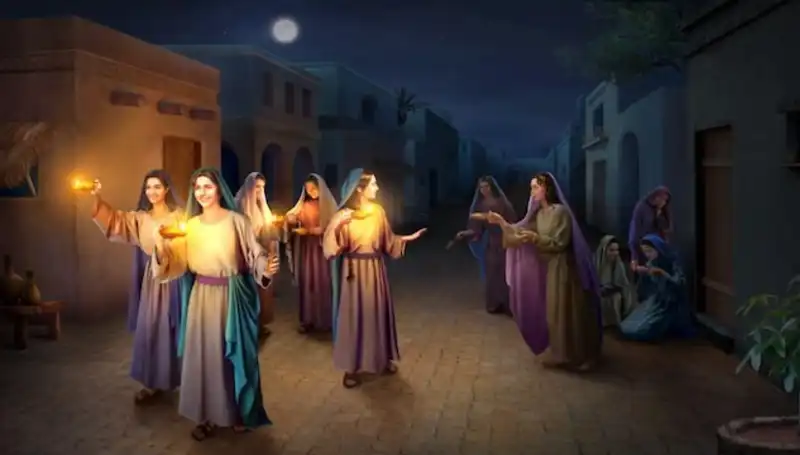
“Then all those virgins arose and trimmed their lamps. And the foolish said to the wise, ‘Give us some of your oil, for our lamps are going out.’” (Matthew 25:7–8)
Deconstructing Misreadings of the Parable of the Ten Virgins
Within the evangelical imagination throughout church history, the Parable of the Ten Virgins (Matthew 25:1–13) has often been associated with the doctrine of the rapture. This interpretation, shaped by dispensationalist eschatology, equates the wise virgins with “believers filled with the Holy Spirit,” while the foolish virgins represent so-called “carnal believers,” unprepared and lacking spiritual fullness. In this interpretative model, the presence or absence of oil is reduced to a moralistic allegory of individual spiritual levels—primarily tied to charismatic experiences—and the exclusion of the foolish virgins is seen as a direct consequence of lacking the Holy Spirit, resulting in their rejection at the time of the rapture.
However, such a reading ignores both the immediate literary context of the parable and the specific eschatological setting Jesus addresses in Matthew 24 and 25. The parable is not directed at the Church as the mystical body of Christ, but rather at the nation of Israel, with the backdrop being the events preceding the visible manifestation of the earthly kingdom of the Messiah in glory—a long-anticipated event for the Jewish people. Just prior, in Matthew 24, Jesus had described the signs that would precede His coming to judge the nations and restore the Kingdom. The exhortation to vigilance in this context does not concern the secret rapture of the Church, but rather the readiness required in light of the eschatological events that will involve Jerusalem and the Jews in the last days.
The moralizing interpretation of the parable—focused on the contrast between “spiritual believers” and “unprepared believers” through the figure of the wise and foolish virgins—also distorts the theological depth of the text. By reducing the oil to a symbol of the Holy Spirit’s presence or a level of personal consecration, the parable’s eschatological significance is hollowed out, assigning a spurious meaning to the symbol and neglecting the prophetic demand for discernment and obedience required of the Jews before Christ’s coming. The parable does not concern differing levels of spirituality among Christians, but a radical division among Jews who, in the end times, will heed the Messiah’s call and those who—though aligned with the promise—will neglect the call to watchfulness.
Thus, before delving into a theological-eschatological analysis of the parable, it is necessary to deconstruct this popular yet exegetically unsupported reading. The Parable of the Ten Virgins is not a moralistic appeal to maintain spiritual anointing but a solemn call to prophetic discernment, fidelity, and preparation in view of the glorious coming of the Son of Man to reign over Israel and rule the nations with a rod of iron—particularly in the context of Israel’s restoration and the fulfillment of eschatological promises.
The Prophetic Identity of the Virgins in Matthew’s Eschatology
The Parable of the Ten Virgins, found in Matthew 25:1–13, forms a direct and organic part of Jesus’ eschatological discourse in chapters 24 and 25 of Matthew’s Gospel. It is one of several parables that make up the final section of the so-called Olivet Discourse, whose emphasis lies on the unpredictability of the Son of Man’s coming for the Jews and the consequent necessity of vigilance. As with the parables of the Faithful and Wise Servant (Matthew 24:45–51) and the Talents (Matthew 25:14–30), this parable contains warnings concerning the future judgment of the nations and Christ’s coming Kingdom, highlighting essential elements expected of the generation of Jews who will live through the period preceding the Kingdom’s restoration to Israel.
The parable’s introduction with the word “Then” (Gr. tóte) creates a clear temporal and logical link to the previous content, especially the warnings found in these verses:
“Watch therefore, for you do not know what hour your Lord is coming. But know this: if the master of the house had known what hour the thief would come, he would have watched and not allowed his house to be broken into. Therefore, you also be ready, for the Son of Man is coming at an hour you do not expect.” (Matthew 24:42–51)
The central figure in the parable—the bridegroom—clearly symbolizes the Messiah, whose coming is certain and unexpected, though delayed (at midnight). The delay causes all the virgins to fall asleep (v. 5), indicating that the issue is not the sleep itself—since both the wise and foolish sleep—but the lack of preparation for the critical moment.
The ten virgins, as a collective, represent the people of Israel in the time leading up to the glorious manifestation of the Messiah. They share the same expectation of the bridegroom’s arrival and appear to be part of the same religious context, tradition, and messianic hope. However, the parable makes a clear distinction between two groups within that collective: five are called wise (phronimoi), and five foolish (morai). The difference is not moral—all are virgins, all wait and are present until the last moment; nor is it in their lamps—all possess them. The difference lies in the oil supply, which in this context represents prudence in the face of the Lord’s apparent delay.
The turning point of the parable is midnight—a symbolic moment signaling the imminence of judgment and the unexpected nature of the Messiah’s coming: a cry is heard—“Here is the bridegroom! Come out to meet him!” (v. 6). At this moment, it becomes clear who was prepared and who was negligent. The wise, having brought extra oil, quickly rise and prepare their lamps. The foolish, realizing their lack, try to negotiate with the wise. Failing that, they go to buy oil—but in doing so, miss the arrival. While they are gone, the bridegroom arrives, the wise go in to the wedding feast, and the door is shut (v. 10). When the foolish virgins return and beg for entry, they hear the solemn and definitive sentence: “Truly, I say to you, I do not know you” (v. 12), an expression echoing the eschatological judgment found in Matthew 7:23.
The exclusion of the foolish virgins illustrates the irrevocable nature of the eschatological decision at the moment of the Son of Man’s coming. The division between the wise and the foolish, those taken and those left (cf. Matthew 24:40–41), is not based on appearance, morality, expectation, or religiosity, but on the unequivocal criteria of persevering watchfulness and concrete obedience to Jesus’ prophetic warning.
Who Are the Wise and Foolish Virgins?
In this specific eschatological context, the wise virgins represent the Jews who, discerning the signs given by Jesus—especially in the Parable of the Fig Tree (Matthew 24:32–33), referring to events described as the “great tribulation” which begins with the “abomination of desolation” in the holy place as prophesied by Daniel (Matthew 24:15)—recognize that the time of the Son of Man’s coming is near. In light of this, they heed Christ’s express instruction:
“Then let those who are in Judea flee to the mountains. Let no one on the housetop go down to take anything out of the house. Let no one in the field go back to get their cloak.” (Matthew 24:16–18)
This is a prophetic imperative requiring immediate obedience in view of the siege of Jerusalem, also foretold by Zechariah:
“All the nations will gather against Jerusalem to wage war… The city will be captured… and half of the city will go into exile.” (Zechariah 14:2)
The foolish virgins, on the other hand, illustrate those Jews who, though part of Israel and expecting the Kingdom, fail to discern the times or obey the prophetic warning. In going out to buy oil at the last moment, they portray those who—at the outbreak of the final events—fail to flee to the mountains and find it already too late. They are those who remain in the city, indifferent or unresponsive to the call to flee, much like those in the days of Noah and Lot who carried on with daily life, unaware of impending judgment (cf. Matthew 24:37–39). Their omission represents a practical unbelief—not necessarily due to ignorance of the Messianic promise, but due to disobedience to revealed instruction.
The truth and urgency of the command to flee the city are confirmed by Jesus’ own words regarding the severity of that time: “Woe to those who are pregnant and to those nursing babies in those days!” (Matthew 24:19). The natural bond with the unborn or infant—who cannot be left behind—will make fleeing more difficult and dangerous. Jesus further warns: “Pray that your flight may not be in winter or on a Sabbath” (Matthew 24:20). Winter implies adverse weather, hindering movement through mountains and desert terrain; the Sabbath may present religious or social obstacles among Jews, creating cultural and spiritual barriers to prompt action. These details make clear that the flight is not symbolic or merely spiritual—it is real, immediate, and unavoidable. Neglecting it could be fatal.
In this framework, the oil acquires a profound theological meaning: it does not symbolize the Holy Spirit but the fervor of obedience to the prophetic warning of the rejected and crucified Rabbi. The oil is the spiritual discernment grounded in Jesus’ foresight about the events leading up to His coming. It cannot be transferred or acquired last minute because it expresses a personal, concrete, and anticipatory reality: being ready to go out and meet the bridegroom when the midnight cry is heard.
It’s important to note that the bridegroom does not come to the virgins—they must go out to meet him (Matthew 25:6). This detail reinforces the active nature of eschatological vigilance. Those who heed the signs—those who flee to the mountains as Jesus instructed—will be taken to meet the Bridegroom. Those who remain in the city, entangled in earthly circumstances, will perish with it—the judged unfaithful city (Isaiah 1:21; 29:1).
Thus, the Parable of the Ten Virgins converges with the eschatological scene in Matthew 24:40–41:
“Then two men will be in the field: one will be taken and the other left. Two women will be grinding at the mill: one will be taken and the other left.”
The division between the five wise and five foolish virgins illustrates the same reality: it is a separation within the very nation of Israel—between those who will be taken because they heeded the call and those who will be left because they did not obey. The symbolic 50/50 proportion reflects Zechariah 14:2, in which “half of the city” goes into exile. The virgins thus represent the entirety of Israel’s population during the tribulation and great tribulation, and the division between them shows that not all who expect the Kingdom will be prepared for the King’s arrival (Isaiah 10:22).
Ultimately, this parable reveals the judgment that the children of Jacob have stored up for themselves, which will fall upon the generation of Jews in Jerusalem in the final days (Romans 2:5). All will, in some way, be waiting for the Messiah; all will have lamps—that is, some form of religiosity or eschatological expectation. But only half will have the oil—obedient faith that discerns the times and responds with action to the prophetic warning. The closed door thus symbolizes not only final exclusion but also the irreversible nature of judgment in the face of disobedience.
Therefore, the Parable of the Ten Virgins not only reinforces the duty of vigilance but unveils the structure of eschatological judgment that will fall upon Israel: a separation within the very people—between those who flee and those who stay, those who are taken and those who are left, those who obeyed and those who neglected the voice of the Son of Man.